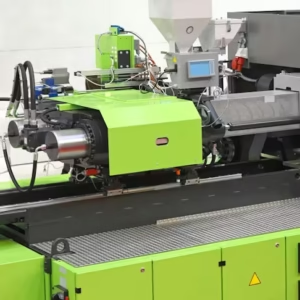
Top 10 Plastic Materials Used in Injection Molding
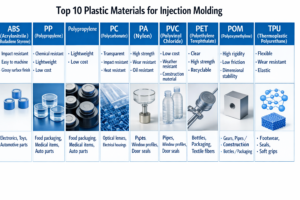
Most Common Plastic Materials for Injection Molding
Choosing the right material is essential for injection molding. Different plastics offer different mechanical properties, heat resistance, and durability.
Below are the top 10 most commonly used plastics in injection molding.
1. ABS (Acrylonitrile Butadiene Styrene)
ABS is widely used due to its strength and impact resistance.
Common applications:
-
electronic housings
-
automotive parts
-
appliances
2. Polypropylene (PP)
PP is lightweight and chemical-resistant.
Common uses:
-
food containers
-
packaging
-
medical products
3. Polycarbonate (PC)
PC offers excellent transparency and impact resistance.
Applications:
-
safety helmets
-
optical lenses
-
electronic components
4. Nylon (PA)
Nylon is known for its high strength and wear resistance.
Used for:
-
gears
-
mechanical parts
-
automotive components
5. Polyethylene (PE)
PE is flexible and cost-effective.
Used in:
-
bottles
-
packaging
-
containers
6. PVC (Polyvinyl Chloride)
PVC provides excellent chemical resistance.
Applications include:
-
pipes
-
medical tubing
-
electrical insulation
7. PET (Polyethylene Terephthalate)
PET is strong, lightweight, and recyclable.
Common uses:
-
beverage bottles
-
packaging materials
8. POM (Acetal)
POM has excellent dimensional stability.
Used in:
-
precision mechanical parts
-
gears
-
bearings
9. PMMA (Acrylic)
PMMA provides high transparency and UV resistance.
Applications:
-
lighting covers
-
display panels
10. TPU (Thermoplastic Polyurethane)
TPU is flexible and durable.
Common uses:
-
phone cases
-
seals
-
protective covers
Conclusion
Material selection plays a crucial role in injection molding. Each plastic material offers unique properties, making it suitable for different applications. Choosing the right plastic ensures better performance, durability, and cost efficiency.